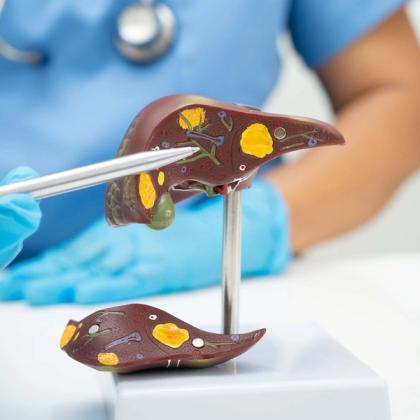
Cirrhosis represents the end stage of chronic liver injury, characterised by fibrosis and regenerative nodules that disrupt normal liver architecture. While the liver can compensate for years, patients often remain asymptomatic until complications such as ascites, variceal bleeding or hepatic encephalopathy arise. Understanding cirrhosis involves exploring its pathophysiology, systemic manifestations, diagnostic tools and management strategies. In this episode, Dr Roger Henderson discusses how chronic insults from viral hepatitis, alcohol or metabolic disease lead to progressive fibrosis, the development of portal hypertension and multisystem involvement.
Key take-home points
- Cirrhosis is the end stage of chronic liver injury, characterised by fibrosis and regenerative nodules that distort the liver’s normal architecture. Over time, this leads to impaired blood flow and progressive loss of hepatic function.
- Many patients remain asymptomatic for years because the liver compensates for injury. Clinical signs often appear only once decompensation or complications develop.
- Hepatic stellate cells play a central role in cirrhosis. When activated by chronic inflammation, they transform into myofibroblasts that produce collagen, driving progressive fibrosis.
- Portal hypertension develops due to both structural changes from fibrosis and dynamic alterations in sinusoidal vascular tone. The resulting increase in portal pressure contributes to complications such as varices, ascites and splenomegaly.
- Cirrhosis affects multiple organ systems beyond the liver. Haematologic, renal, pulmonary, endocrine and dermatologic changes often occur, reflecting both systemic effects of liver dysfunction and portal hypertension.
- Management focuses on preventing further liver injury, addressing complications and treating the underlying cause. Lifestyle modifications, pharmacologic therapy and surveillance for hepatocellular carcinoma are key strategies to improve outcomes.
- The most common causes of cirrhosis include chronic viral hepatitis, alcohol-related liver disease and non-alcoholic steatohepatitis, with geography influencing prevalence.
- Aspartate aminotransferase (AST) often exceeds alanine aminotransferase (ALT) in advanced cirrhosis, particularly in alcoholic liver disease, resulting in a reversal of the usual AST/ALT ratio.
- Low serum albumin and prolonged prothrombin time are reliable indicators of impaired hepatic synthetic function.
- Thrombocytopenia is an early marker of portal hypertension, often caused by splenic sequestration.
- Ultrasound is the first-line imaging modality, capable of detecting nodularity, heterogeneous liver texture, splenomegaly and portosystemic collaterals.
- Computed tomography and magnetic resonance imaging scans provide superior detection of hepatocellular carcinoma, vascular complications and tissue characterisation in cirrhosis.
- Transient elastography (FibroScan) offers a non-invasive assessment of liver stiffness, correlating with the degree of fibrosis.
- Liver biopsy remains the gold standard for diagnosis, grading fibrosis and sometimes identifying the underlying cause.
- Cirrhosis significantly increases the risk of hepatocellular carcinoma, making routine surveillance essential for early detection.
Key references
- NICE. 2023. https://www.nice.org.uk/guidance/ng50.
- Tapper EB, Pairkh ND. JAMA. 2023;329(18):1589-1602. doi: 10.1001/jama.2023.5997.
- EASL. J Hepatol. 2018;69(2):406-460. doi: 10.1016/j.jhep.2018.03.024.
- de Franchis R, et al. J Hepatol. 2022;76(4):959-974. doi: 10.1016/j.jhep.2021.12.022.
- Rogal SS, et al. Hepatology. 2022;76(3):819-853. doi: 10.1002/hep.32378.
Create an account to add page annotations
Add information to this page that would be handy to have on hand during a consultation, such as a web address or phone number. This information will always be displayed when you visit this page