Ca125 (Ca - 125) - NICE urgent cancer referral guidance
With respect to possible Ca125 and ovarian cancer (1):
- a referral to a gynaecological cancer service using a suspected cancer pathway referral should be made if physical examination identifies ascites and/or a pelvic or abdominal mass (which is not obviously uterine fibroids)
- tests should be carried out in primary care (see below) if a woman, or a trans man or non-binary person with female reproductive organs (especially if they are aged 50 or over) reports having any of the following symptoms on a persistent or frequent basis – particularly more than 12 times per month:
- persistent abdominal distension (often referred to as 'bloating')
- feeling full (early satiety) and/or loss of appetite
- pelvic or abdominal pain
- increased urinary urgency and/or frequency
- consider carrying out tests in primary care (see below) if a woman, or a trans man or non-binary person with female reproductive organs reports unexplained weight loss, fatigue or changes in bowel habit
- any woman, or trans man or non-binary person with female reproductive organs, who is not suspected of having ovarian cancer, should be advised to return to their GP if their symptoms become more frequent or persistent, or both
- carry out appropriate tests for ovarian cancer (see below) in any woman, or trans man or non-binary person with female reproductive organs who is aged 50 or over and who has experienced symptoms within the last 12 months that suggest irritable bowel syndrome (IBS), because IBS rarely presents for the first time at this age
Suggested tests (1):
- for women, and trans men and non-binary people with female reproductive organs who are aged 39 or under with persistent symptoms that suggest ovarian cancer (see above):
- do not use serum CA125 measurement in isolation for decision making (it is not an accurate indicator of ovarian cancer risk in this age group; although the risk of ovarian cancer is low, it remains a clinical concern and is often diagnosed late)
- consider an urgent, direct access ultrasound scan of the abdomen and pelvis
- if the ultrasound scan is normal:
- identify any other potential causes of the symptoms and investigate as appropriate, and
- if no other cause is identified, advise a return to the GP if the symptoms become more frequent or persistent, or both
- for women, and trans men and non-binary people with female reproductive organs who are aged 40 or over with persistent symptoms that suggest ovarian cancer, measure CA125 in primary care
- arrange an urgent, direct access ultrasound scan of the abdomen and pelvis depending on age and serum CA125 according to the thresholds in table below:
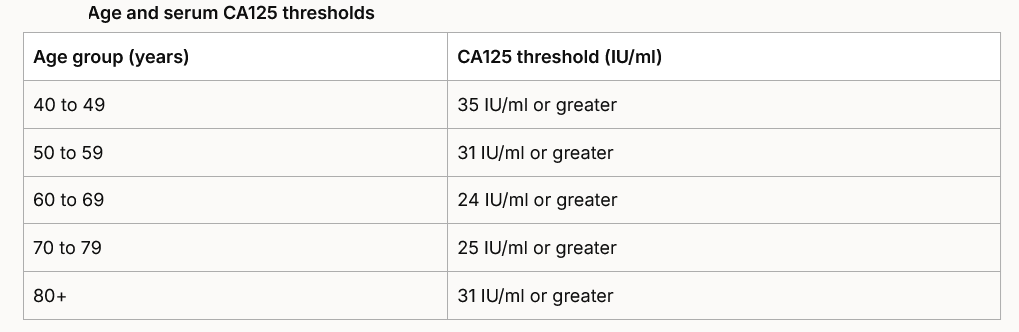
If an ultrasound scan suggests ovarian cancer, make a referral to a gynaecological cancer service using a suspected cancer pathway referral.
If the serum CA125 does not meet the threshold outlined above, or meets the threshold but the ultrasound scan is normal:
- identify any other potential causes of the symptoms and investigate as appropriate, and
- if no other cause is identified, advise a return to the GP if the symptoms become more frequent or persistent, or both
The NICE committee noted (1):
- Moderate-certainty evidence showed that in women over 50, serum CA125 levels meet the predictive value needed to justify a strong recommendation to arrange an ultrasound scan. Based on the clinical and health economic evidence, the committee agreed age-specific thresholds in 10-year age bands for this age group.
- For people aged 40 to 49 years, although the evidence was less certain and did not meet the required predictive value needed to justify a strong recommendation to arrange an ultrasound scan, the CA125 threshold of 35 U/ml or over still shows moderate‑to-high sensitivity. The committee agreed that for this age group, the measurement of CA125 remains useful in guiding decisions about further investigations.
- The low prevalence of ovarian cancer in younger age groups affects serum CA125 performance, which increases the risk of false reassurance and late diagnosis, particularly in those aged 39 and under. For this age group, the committee agreed that serum CA125 is not sufficiently accurate to support decision making. Therefore, the committee recommended that serum CA125 should not be used in isolation to guide suspected ovarian cancer decisions. The committee recommended considering an ultrasound scan for those with persistent symptoms. The committee also agreed the importance of safety netting for those aged 39 and under, and recommended that if an ultrasound scan is normal, other potential causes of symptoms should be investigated and people advised about when to return to their GP.
Reference:
Related pages
Create an account to add page annotations
Annotations allow you to add information to this page that would be handy to have on hand during a consultation. E.g. a website or number. This information will always show when you visit this page.