UK MEC and obesity
UKMEC guidance and obesity
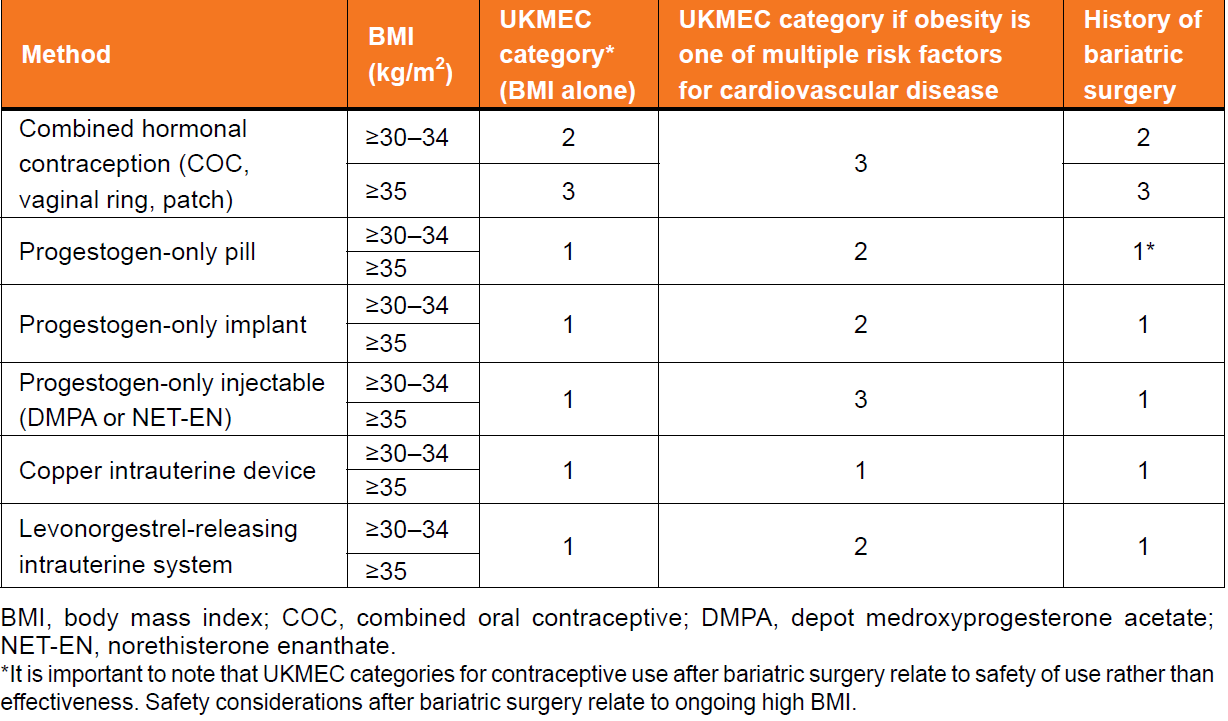
For women with obesity (BMI categories of >=30-34 kg/m2 and >=35 kg/m2) without coexistent medical conditions
- the UKMEC previously categorised all progestogen-only contraceptives and intrauterine contraception as UKMEC 1, which means that there were no restrictions on the use of these methods.
- the biggest single change in the 2025 UKMEC guidelines is probably in use of the depot medroxyprogesterone acetate (DMPA) injection. It has generally been classed with other progestogen-only methods, but observational studies have shown that its VTE risk is higher than previously thought, although still lower than that of combined hormonal contraception (CHC). This means it is now a category 2 classification rather than category 1, meaning a condition where the advantages of using the method generally outweigh the theoretical or proven risks.
For women with obesity (BMI categories of >=30-34 kg/m2 and >=35 kg/m2) of all ages, all oestrogen containing contraception (i.e. combined hormonal contraception (CHC), including combined oral contraception (COC) containing both oethinylestradiol (EE) and oestradiol, patch and ring)
- categorised as UKMEC 2 or 3, depending on BMI. These categorisations are primarily because of increased risk of VTE.
For women with raised BMI with other risk factors for CVD in addition to obesity (e.g. smoking, diabetes, hypertension and dyslipidaemias)
- the copper intrauterine device (Cu-IUD) remains UKMEC 1
- the levonorgestrel-releasing intrauterine system (LNG-IUS), contraceptive implants and the progestogen-only pill (POP) are UKMEC 2
- progestogen-only injectables (depot medroxyprogesterone acetate (DMPA) and norethisterone enanthate (NET-EN)) and CHC are classed as UKMEC 3.
It is important to note that UKMEC categories for contraceptive use after bariatric surgery relate to safety of use rather than effectiveness. Safety considerations after bariatric surgery relate to ongoing high BMI - see linked item
UK Medical Eligibility Criteria for Contraceptive Use (UKMEC) categories based on body mass index:
Reference:
- College of Sexual and Reproductive Healthcare. UK Medical Eligibility Criteria for Contraceptive Use. UKMEC 2025
Related pages
- UKMEC (UK Medical Eligibility for Contraceptive Use) criteria
- UK Medical Eligibility Criteria for Contraceptive Use (UKMEC) recommendations for contraceptive safety following bariatric surgery
- Contraception
- Intrauterine contraception (IUC) and obesity
- Progestogen only implant (contraceptive) and obesity
- Progestogen only injectable contraceptive (contraception) and obesity
- Progestogen only pill (POP) and obesity
- Obesity and combined oral contraceptive
- Emergency contraception (EC) and obesity
Create an account to add page annotations
Annotations allow you to add information to this page that would be handy to have on hand during a consultation. E.g. a website or number. This information will always show when you visit this page.