National Early Warning Score (NEWS)
Overview
- National Early Warning Score 2 (NEWS2) is a validated track-and-trigger scoring system used across healthcare settings to identify and respond to acutely deteriorating patients (1)
- allocates a score (0–3) across six physiological parameters based on variance from normal ranges, plus 2 points if supplemental oxygen is required, giving an aggregate score of 0–20 (1)
- guidance in NICE NG253 formally incorporates NEWS2 thresholds to grade sepsis risk and trigger specific antimicrobial and escalation timelines (2)
Physiological Parameters and Scoring Chart the six routine physiological parameters assessed in NEWS2 are (1):
- respiration rate
- oxygen saturations (using dedicated Scale 1 or Scale 2 for hypercapnic respiratory failure)
- systolic blood pressure
- pulse rate
- level of consciousness or new confusion (CVPU scale: Alert, Voice, Pain, Unresponsive, or new Confusion)
- temperature
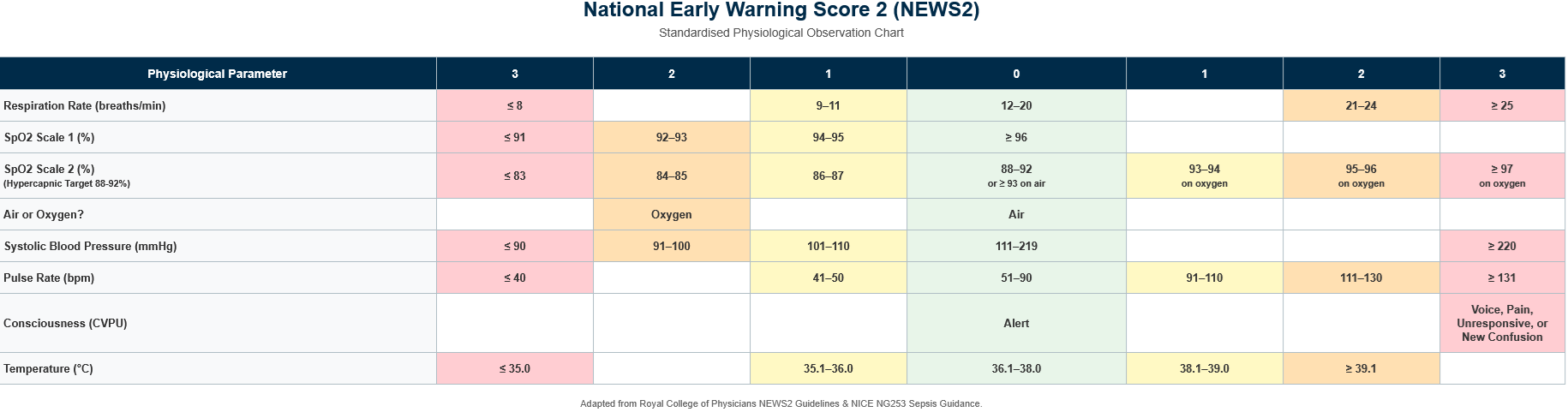
Sepsis Risk Stratification and Trigger Thresholds in acute hospital settings, ambulances, and mental health facilities, aggregate NEWS2 scores categorize sepsis risk and guide clinical management (2):
- high risk: NEWS2 score >= 7, or NEWS2 score 5–6 with a single parameter red flag (2)
- moderate risk: NEWS2 score 5–6, or NEWS2 score 3–4 with a single parameter red flag
- low risk: NEWS2 score 1–4
- very low risk: NEWS2 score 0
Single Parameter Red Flag Rule: a score of 3 in any single physiological parameter represents a red flag and requires urgent, high-priority review by an FY2+ clinician to evaluate escalating the sepsis risk tier (2).
Management Timelines Based on NEWS2 Sepsis Risk
High Risk (NEWS2 >= 7)
- initiate broad-spectrum IV antibiotics within 1 hour of initial NEWS2 calculation (2)
- begin immediate fluid resuscitation (250 ml isotonic crystalloid boluses) and obtain full diagnostic blood panel including lactate and blood cultures
- recalculate NEWS2 every 30 minutes; escalate to senior decision-maker or critical care if no clinical improvement within 1 hour
Moderate Risk (NEWS2 5–6)
- review by FY2+ clinician within 1 hour
- broad-spectrum antibiotics may be deferred up to 3 hours to allow diagnostic workup, culture collection, and targeted identification of infection source
- consider procalcitonin (PCT) testing alongside routine venous bloods
Low Risk (NEWS2 1–4)
- review by registered health practitioner
- antibiotics may be deferred up to 6 hours for diagnostic workup
References
- Royal College of Physicians. National Early Warning Score (NEWS) 2: Standardising the assessment of acute-illness severity in the NHS. RCP London.
- National Institute for Health and Care Excellence (NICE). Suspected sepsis in people aged 16 or over: recognition, assessment and early management (NG253). Published Nov 2025, updated Sep 2026.
Create an account to add page annotations
Annotations allow you to add information to this page that would be handy to have on hand during a consultation. E.g. a website or number. This information will always show when you visit this page.