Polycythaemia
Traditionally, polycythaemia describes a group of varied disorders with an increase in the number of circulating red cells above established normal limits (erythrocytosis is the appropriate term since only the red cell lineage is involved in the disease) (1).
Age, sex, nutritional status and residential altitude all contribute to natural variations. As a guideline, erythrocytosis should be suspected when there is persistently raised venous haematocrit (Hct) (>0.52 males, >0.48 females for > 2 months) or haemoglobin (in men greater than 18.0 g per L or in women with values greater than 17.0 g per L) (1).
The increased blood viscosity associated with polycythaemia increases the risk of thrombotic complications.
Erythrocytosis can be:
- absolute – both haematocrit (Hct) level and red cell mass are elevated
- apparent – people with raised venous haematocrit (Hct) but with a red cell mass within reference range
True increased red cell mass (rather than apparent erythrocytosis) can be assumed when the haematocrit is over 60% in males and 56% in females (1)
Note that normal ranges vary with different commercial kits.
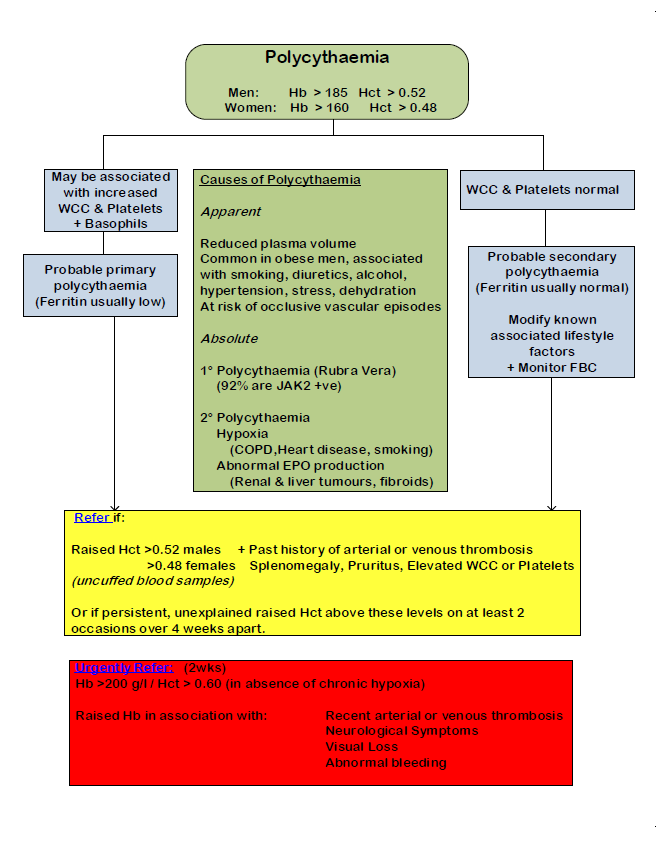
A schemata for considering polycythaemia in adults is presented (2):
Reference:
- Tefferi A, Barbui T. Polycythemia vera: 2024 update on diagnosis, risk-stratification, and management. Am J Hematol. 2023 Sep;98(9):1465-87.
- NHS Camden CCG. Abnormal FBC guidance - for adults
Related pages
Create an account to add page annotations
Annotations allow you to add information to this page that would be handy to have on hand during a consultation. E.g. a website or number. This information will always show when you visit this page.