NICE - algorithm for management of glycaemia (glucose) in type 2 diabetes
Confirm diagnosis of type 2 diabetes
- refer to practice nurse for baseline assessments for diabetes - feet, urine, BMI; refer for retinal screening
- refer for DESMOND or equivalent
- modified release metformin and a sodium–glucose cotransporter-2 (SGLT-2) is generally the first line treatment option in type 2 diabetes (1)
NICE suggest targets for management of type 2 diabetes as (1)
Targets
- for adults whose type 2 diabetes is managed either by healthy living and diet, or healthy living and diet combined with an initial medication regimen that is not
associated with hypoglycaemia, support them to aim for an HbA1c level of 48 mmol/mol (6.5%) - for adults on a drug associated with hypoglycaemia, support the person to aim for an HbA1c level of 53mmol/mol (7.0%)
- in adults with type 2 diabetes, if HbA1c levels are not adequately controlled by a single drug and rise to 58 mmol/mol (7.5%) or higher:
- reinforce advice about diet, lifestyle and adherence to drug treatment and
- support the person to aim for an HbA1c level of 53mmol/mol (7.0%)
- and intensify drug treatment
- consider relaxing the target HbA1c level on a case-by-case basis, with particular consideration for people who are older or frail, for adults with type 2 diabetes:
- who are unlikely to achieve longer-term risk-reduction benefits, for example, people with a reduced life expectancy
- for whom tight blood glucose control poses a high risk of the consequences of hypoglycaemia, for example, people who are at risk of falling, people who have impaired awareness of hypoglycaemia, and people who drive or operate machinery as part of their job
- for whom intensive management would not be appropriate, for example, people with significant comorbidities
- if adults with type 2 diabetes achieve an HbA1c level that is lower than their target and they are not experiencing hypoglycaemia, encourage them to maintain it. Be aware that there are other possible reasons for a low HbA1c level, for example, deteriorating renal function or sudden weight loss
HbA1c lower than target:
- If adults with type 2 diabetes achieve an HbA1c level that is lower than their target and they are not experiencing hypoglycaemia, encourage them to maintain it
- be aware that there are other possible reasons for a low HbA1c level, for example, deteriorating renal function or sudden weight loss
The usual first line therapy in type 2 diabetes management is, in general, modified release metformin plus an SGLT2 inhibitor. The first line therapy options are detailed below (1):
(1) Adults with type 2 diabetes and no relevant comorbidities
Offer:
- modified-release metformin, and
- an SGLT-2 inhibitor
If metformin is contraindicated or not tolerated, offer monotherapy with an SGLT-2 inhibitor
(2) Adults with heart failure (with any ejection fraction, unless specified)
Offer:
- modified-release metformin, and
- an SGLT-2 inhibitor
If metformin is contraindicated or not tolerated, offer monotherapy with an SGLT-2 inhibitor
(3) Adults with atherosclerotic cardiovascular disease
Offer:
- modified-release metformin, and
- an SGLT-2 inhibitor, and
- subcutaneous semaglutide (Ozempic), up to 1 mg once a week, for its cardiovascular, renal and glycaemic benefits.
If metformin is contraindicated or not tolerated, offer:
- an SGLT-2 inhibitor, and
- subcutaneous semaglutide (Ozempic), up to 1 mg once a week, for its cardiovascular, renal and glycaemic benefits
(4) People with early onset type 2 diabetes (diabetes that has been diagnosed before the age of 40)
For adults with early onset type 2 diabetes, offer modified-release metformin and an SGLT-2 inhibitor, and consider adding either:
- a GLP-1 receptor agonist for its cardiovascular, renal and glycaemic benefits
- or
- tirzepatide for its glycaemic benefits.
If metformin is contraindicated or not tolerated, offer an SGLT-2 inhibitor and consider adding either:
- a GLP-1 receptor agonist for its cardiovascular, renal and glycaemic benefits
- or
- tirzepatide for its glycaemic benefits
(5) Adults living with obesity
If considering medicines primarily for weight management, see information about medicines for overweight and obesity in NICE's guideline on overweight and obesity management.
Offer:
- modified-release metformin, and
- an SGLT-2 inhibitor
If metformin is contraindicated or not tolerated, offer monotherapy with an SGLT-2 inhibitor.
Adding a GLP-1 receptor agonist or tirzepatide for adults with type 2 diabetes who are living with obesity, should be considered if:
- they have been taking initial therapy for at least 3 months and
- further medicines are needed to reach their individualised glycaemic targets
- and they are not already taking a GLP-1 receptor agonist or tirzepatide
For adults with type 2 diabetes who are living with obesity who need further medicines to reach their individualised glycaemic targets and for whom a GLP-1 receptor agonist or tirzepatide is contraindicated, not tolerated, not appropriate or not effective:
- offer to add a DPP-4 inhibitor to their current treatment
- if this is contraindicated, not tolerated or not effective, offer to add:
- a sulfonylurea or
- pioglitazone or
- an insulin-based treatment (see the section on insulin-based treatments)
For adults with type 2 diabetes who are living with obesity who need further medicines to reach their individualised glycaemic targets and are already taking a
GLP-1 receptor agonist or tirzepatide, offer to add:
- a sulfonylurea or
- pioglitazone or
- an insulin-based treatment (see the section on insulin-based treatments)
(6) Adults with chronic kidney disease
If type 2 diabetes and an estimated glomerular filtration rate (eGFR) above 30 ml/min/1.73 m2:
- offer modified-release metformin and an SGLT-2 inhibitor.
- If metformin is contraindicated or not tolerated, offer monotherapy with an SGLT-2 inhibitor
If type 2 diabetes and an eGFR of 20 ml/min/1.73 m2 and up to 30 ml/min/1.73 m2, offer:
- either dapagliflozin or empagliflozin and
- a DPP-4 inhibitor.
If type 2 diabetes and an eGFR below 20 ml/min/1.73 m2, consider a DPP-4 inhibitor.
If a DPP-4 inhibitor is contraindicated, not tolerated or not effective, consider:
- pioglitazone or
- an insulin-based treatment
(7) Adults with frailty
For adults with type 2 diabetes and frailty:
- modified-release metformin should be offered
- an SGLT2 inhibitor should only be offered if the person's level of frailty does not place them at risk of adverse events from such a medicine (for example, volume depletion or hypotension)
If metformin is contraindicated or not tolerated, assess whether their level of frailty places the person at risk of adverse events from SGLT-2 inhibitors:
- if it does not, consider monotherapy with a SGLT-2 inhibitor
- if it does, consider monotherapy with a DPP-4 inhibitor
Introducing medicines in a stepwise manner
Medicines should be introduced in a stepwise manner, checking for tolerability and effectiveness of each medicine.
When an adult with type 2 diabetes starts initial therapy with metformin and one or more other medicines:
- introduce the medicines one at a time, starting with metformin and checking tolerability
- if using an SGLT-2 inhibitor, start this as soon as metformin is at the maximum tolerated dose
- if using a GLP-1 receptor agonist or tirzepatide, start this as soon as the SGLT-2 inhibitor is at the maximum tolerated dose
Reviewing metformin
For adults with type 2 diabetes who are already taking standard-release metformin:
- continue with this treatment or
- switch to modified-release metformin if standard-release metformin is not tolerated or if this is the person's preference
Reviewing other medicines
- consider continuing SGLT-2 inhibitors for their cardiovascular or renal benefits, even if they do not help the person reach their individualised glycaemic targets.
- stop GLP-1 receptor agonists or tirzepatide if the person becomes underweight (BMI under 18.5 kg/m2).
- stop GLP-1 receptor agonists or tirzepatide if they do not help the person reach their individualised glycaemic targets and they are not being taken for their cardiovascular benefits.
- do not offer both a GLP-1 receptor agonist or tirzepatide and a DPP-4 inhibitor together to treat type 2 diabetes
Do not routinely offer self-monitoring of blood glucose levels for adults with type 2 diabetes unless:
- the person is on insulin or
- there is evidence of hypoglycaemic episodes or
- the person is on oral medication that may increase their risk of hypoglycaemia while driving or operating machinery
- or the person is pregnant, or
- is planning to become pregnant. For more information, see the NICE guideline on diabetes in pregnancy
Consider short-term self-monitoring of capillary blood glucose levels in adults with type 2 diabetes, reviewing treatment as necessary:
- when starting treatment with oral or intravenous corticosteroids or
- to confirm suspected hypoglycaemia
Graphical summary:
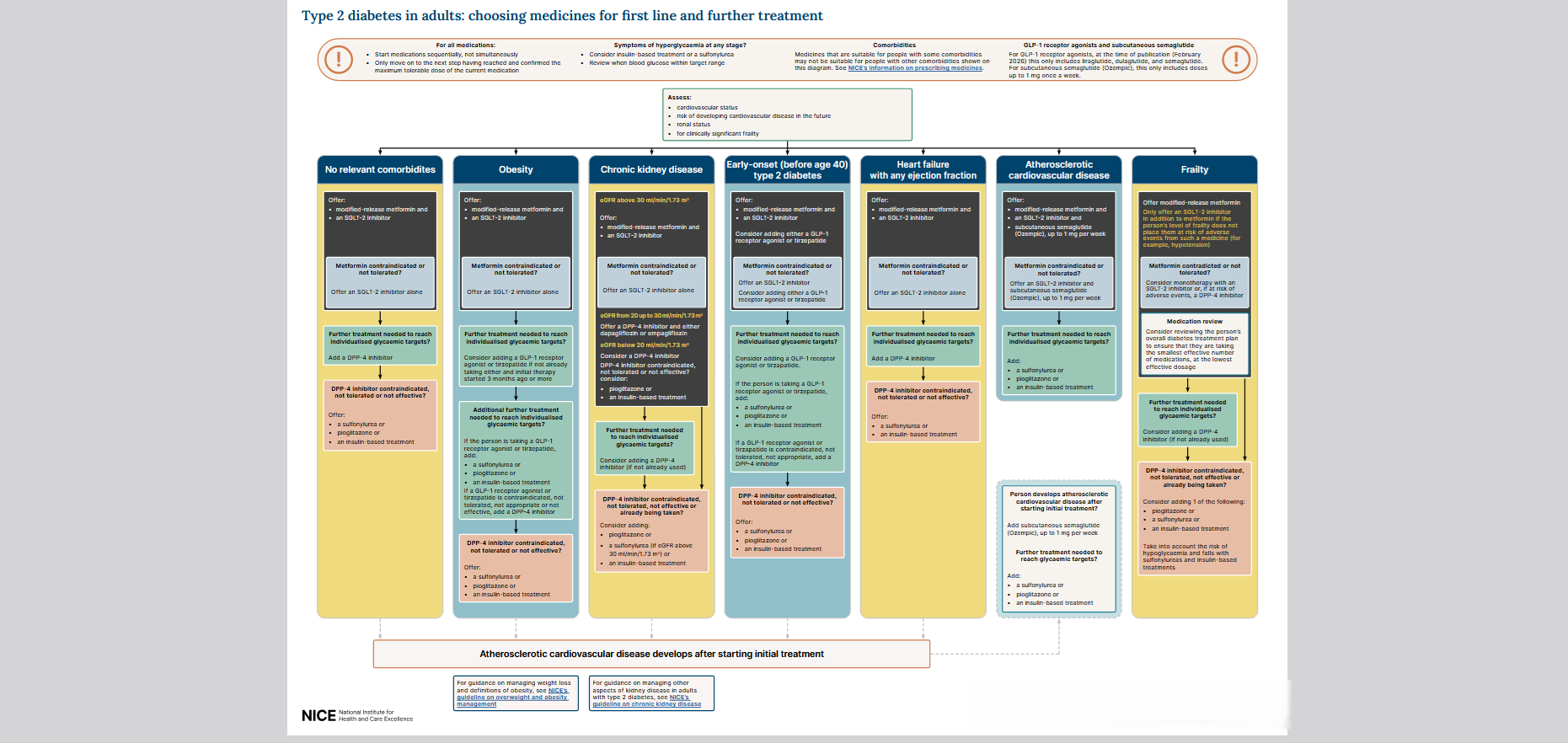
For detailed guidance then consult the full guideline.
Notes:
- LADA
- patients with LADA are relatively 'insulin deficient' rather than 'insulin resistant'. These patients do not have the classic type 2 diabetic phenotype. These patients are likely to require insulin earlier in their management compared to 'insulin resistant' diabetics. Caution is required in management of these patients because insulin therapy may be indicated from diagnosis of diabetes in these patients if presenting with persistently high blood glucose values
Reference:
Related pages
- NICE guidance - adults with type 2 diabetes and no relevant comorbidities
- NICE guidance - adults with type 2 diabetes and heart failure (with any ejection fraction, unless specified)
- NICE guidance - adults with type 2 diabetes and atherosclerotic cardiovascular disease
- NICE guidance - people with early onset type 2 diabetes (diabetes that has been diagnosed before the age of 40)
- NICE guidance - adults with obesity and type 2 diabetes
- NICE - glycaemic control in adults with chronic kidney disease (CKD) and type 2 diabetes
- NICE guidance - type 2 diabetes in adults with frailty
Create an account to add page annotations
Annotations allow you to add information to this page that would be handy to have on hand during a consultation. E.g. a website or number. This information will always show when you visit this page.