Hearing loss
Hearing loss is a major public health issue affecting about 9 million people in England
- because age-related hearing loss is the most common type of hearing loss, it is estimated that by 2035 there will be around 13 million people with hearing loss in England - a fifth of the population
- the psychological, financial and health burden of hearing loss can be reduced by prompt and accurate referral, robust assessment and correct management
hearing loss (2,3)
- may occur at any age
- impairs verbal communication
- may be unilateral or bilateral
- can be classified as :
- conductive - lesions in the outer or middle ear
- sensorineural -lesions in the inner ear or auditory nerve
- mixed - both, conductive and sensorineural hearing loss involved
- central - caused by lesions along the auditory pathway or in the brain
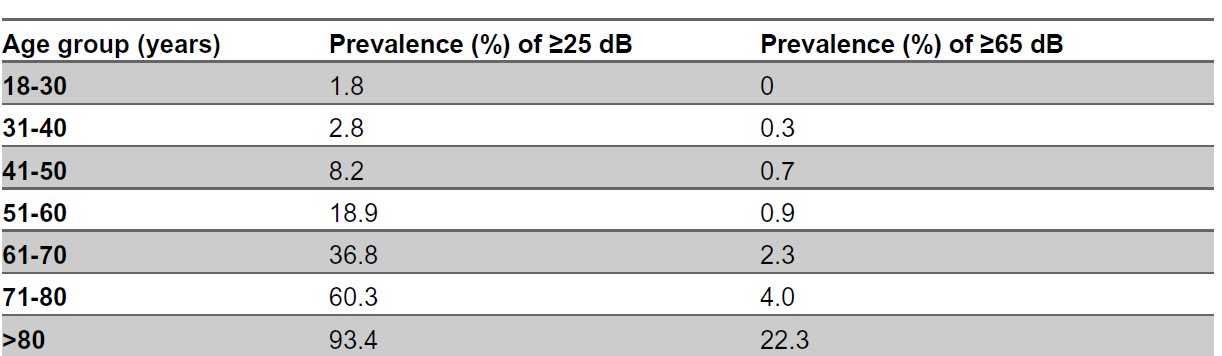
The prevalence of deafness based on age group has been stated (4):
Notes:
Normal Hearing | -10-26 dB |
Mild Hearing Impairment | 27-40 dB |
Moderate Hearing Impairment | 41-55 dB |
Moderately Severe Impairment | 56-70 dB |
Severe Hearing Impairment | 71-90 dB |
Profound Hearing Impairment | >= 91 dB |
Reference:
- NICE. Hearing loss in adults: assessment and management. NICE guideline NG98. Published June 2018, last updated October 2023
- Isaacson B. Hearing loss. Med Clin North Am. 2010 Sep;94(5):973-88
- Chandrasekhar SS, Tsai Do BS, Schwartz SR, et al. Clinical Practice Guideline: Sudden Hearing Loss (Update). Otolaryngol Head Neck Surg. 2019 Aug;161(1_suppl):S1-S45.
- NHS England. Hearing loss data tool 2019 https://www.england.nhs.uk/publication/joint-strategic-needs-assessment-toolkit/2016
Related pages
Create an account to add page annotations
Annotations allow you to add information to this page that would be handy to have on hand during a consultation. E.g. a website or number. This information will always show when you visit this page.